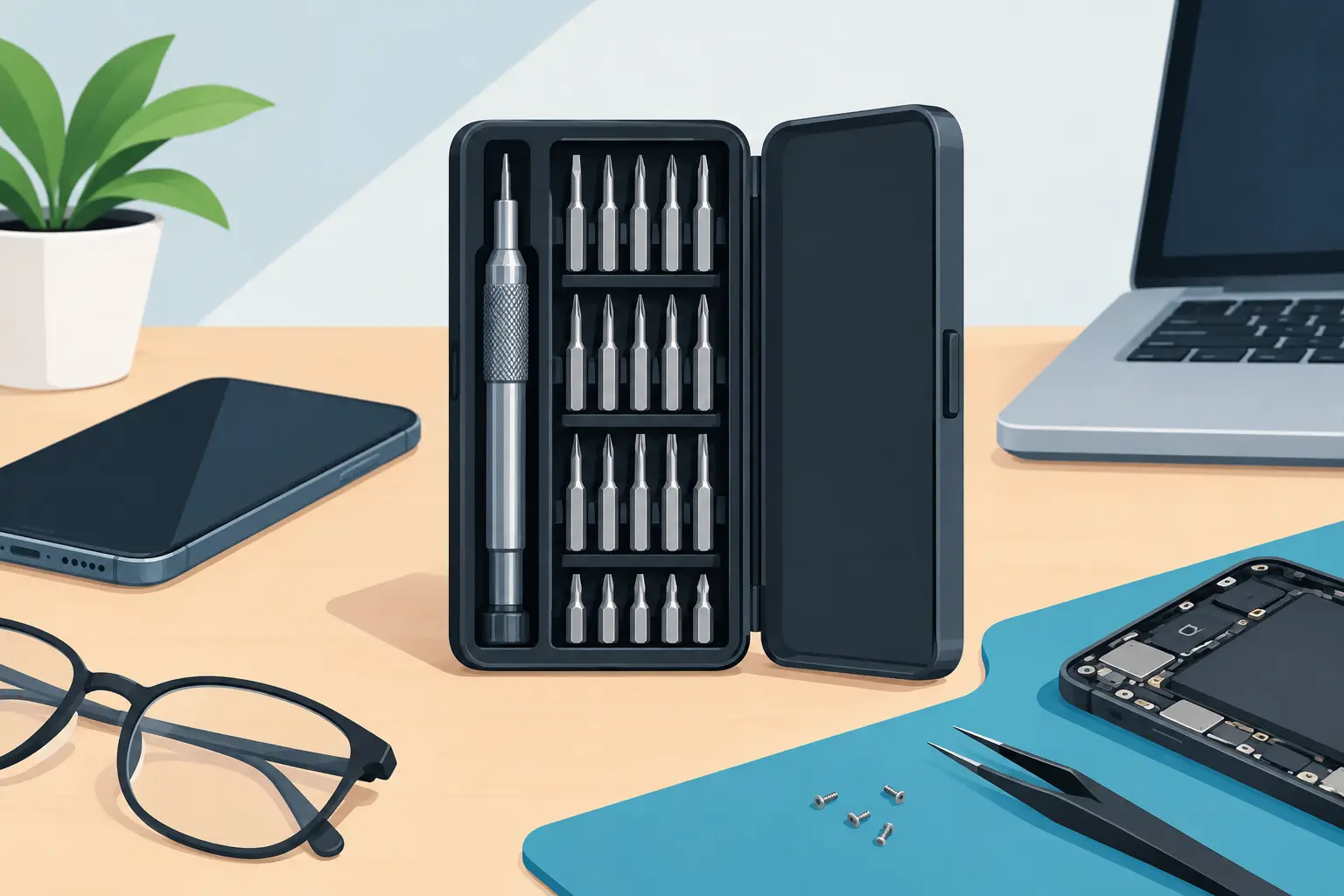
A stripped phone screw or loose eyeglass hinge can stop a simple repair before it starts. The best precision screwdriver set gives you the right bit, a controlled grip, and a way to keep tiny hardware from disappearing across the workbench. For most buyers, that matters more than buying the set with the highest piece count.
A good kit earns its space in a desk drawer, garage, repair bag, or travel tech pouch. It should handle common electronics, small appliances, toys, watches, glasses, and controller repairs without rounded bits, loose handles, or a case that scatters pieces every time it opens.
What Makes the Best Precision Screwdriver Set?
Start with fit. Precision fasteners are small, shallow, and easy to damage. A bit that is slightly too small can slip, chew up the screw head, and turn a five-minute battery replacement into a frustrating extraction job. The best set has accurately machined bits that seat firmly before you apply pressure.
Material matters next. Hardened steel bits generally hold their shape better through repeated use than soft, bargain-grade metal. That does not mean every home user needs an expensive technician kit. It does mean the cheapest set can cost more in the long run if its Phillips bit twists after a few repairs.
The driver handle should feel stable between your fingers. Look for a rotating end cap, often called a swivel cap, if you work on phones, laptops, handheld consoles, or other devices with many small screws. It lets you press down with one hand while turning the shaft with your fingertips. Knurled or textured sides also help when a screw is stubborn.
A secure case is part of the tool, not an afterthought. Individual labeled slots reduce setup time and make missing bits obvious. Magnetic retention is convenient, but it should be strong enough to hold bits in place when the case is carried upright. For mobile repairs, a compact case with a positive latch is usually better than a wide tray.
Choose Bits for the Devices You Actually Repair
More bits are useful only when they match the work in front of you. A basic household kit may only need Phillips, flathead, Torx, and a few hex sizes. Device repair calls for a broader selection because manufacturers use specialty screws to discourage casual tampering and to fit tight spaces.
For phones, tablets, laptops, cameras, game controllers, and small appliances, look for the common precision profiles: Phillips, flathead, Torx, security Torx, pentalobe, tri-point, tri-wing, hex, and square. A set that includes several sizes within each profile is more useful than one that adds dozens of duplicate or rarely used pieces.
Pentalobe bits are frequently needed for certain smartphones and laptops. Tri-point and tri-wing bits appear in handheld electronics and some battery compartments. Security Torx bits have a small hole that accepts screws with a center pin. If you see a star-shaped screw that a standard Torx bit will not fit, security Torx is likely the answer.
Watch and eyeglass work is a separate consideration. Very small slotted and Phillips drivers can be more practical than interchangeable bits because they offer a slimmer shaft and clearer control. If these repairs are a priority, check the smallest listed sizes rather than assuming every large kit goes fine enough.
The Right Set Size Depends on the Job
A 20- to 35-piece kit is often enough for basic home fixes, glasses, toys, and occasional electronics work. It is compact, simple to sort, and usually the best value for someone who does not open devices every week.
A 50- to 80-piece kit suits active DIY users and gadget owners. This range commonly adds specialty bits, extension shafts, tweezers, and opening tools. It is a strong middle ground when your household includes laptops, consoles, smart devices, small appliances, and furniture with varied hardware.
Larger 100-plus-piece kits make sense for frequent repair work, makers, technicians, or small-business operations. They can cover a wide mix of fasteners and often include flexible extensions, magnetic mats, suction cups, and spudgers. The trade-off is that a bigger kit takes longer to organize and may include accessories you never use. Buy the coverage you need, not the largest number on the package.
Look Beyond the Screwdriver Bits
The right accessory can prevent cosmetic damage and save time. For electronics repairs, non-marring plastic opening picks and spudgers help separate clips without gouging a housing. Fine-point tweezers are useful for lifting screws, reconnecting small cables, and handling springs.
A flexible extension is worthwhile when screws sit behind a bracket or at an awkward angle. Use it for access, not for high torque. Flexible shafts can wobble, and forcing a tight screw with one increases the chance of slipping.
Magnetic features require a little judgment. A magnetized driver tip helps hold tiny screws, especially inside a laptop or camera body. However, do not place strong magnets directly against storage media or use them carelessly around delicate components. For ordinary fastener handling, light magnetization is practical and common.
If you often take devices apart, a magnetic project mat or labeled parts tray is more valuable than another set of duplicate bits. Small screws can look identical while having different thread lengths. Returning a long screw to the wrong hole can damage a display, board, or internal frame.
How to Use a Precision Set Without Damaging Screws
Before turning anything, inspect the screw head under good light and choose the bit that fills it cleanly. Insert the bit fully, keep the driver straight, and apply gentle downward pressure as you turn. If the driver cams out or feels loose, stop and try the next size rather than pushing harder.
For a stuck screw, use steady pressure and short, controlled turns. Do not rush to power tools. Precision screws strip quickly, and high-speed drivers can crack plastic posts or snap delicate threads. A manual screwdriver gives better feedback and is usually the safer choice for electronics.
Keep removed screws organized in order. A simple row on a magnetic mat works, or use small labeled containers for larger jobs. Take a quick photo before disconnecting cables or removing shields. These habits cost almost nothing and make reassembly far less stressful.
When a Budget Set Is Enough - and When to Upgrade
An entry-level precision set is a smart buy for occasional repairs, especially when you need a specific bit for one device or want a compact household toolkit. It can handle loose hinges, battery doors, small toys, cabinet hardware, and many routine gadget fixes. The key is to avoid forcing it beyond its limits.
Upgrade to a better-built set if you repair several devices a month, regularly encounter stuck screws, or rely on your tools for paid work. Better machining, stronger bit retention, a more comfortable handle, and a durable case become noticeable when the tool is used often. Replacing worn bits is also easier when the kit uses standard bit formats.
For value-conscious buyers, focus on the essentials: hardened bits, the specialty profiles your devices use, a swivel-cap driver, and a case that keeps everything organized. A pro-grade kit does not have to be oversized or overpriced. It has to work accurately when a tiny screw is the only thing between you and a completed repair.
VOLTKITS carries practical tools and device accessories for home, garage, and workbench use, with fast US shipping in 2-4 business days and a 30-day return policy. Choose the set that fits your real repair list, then keep it where you can reach it before a small problem becomes an expensive replacement.