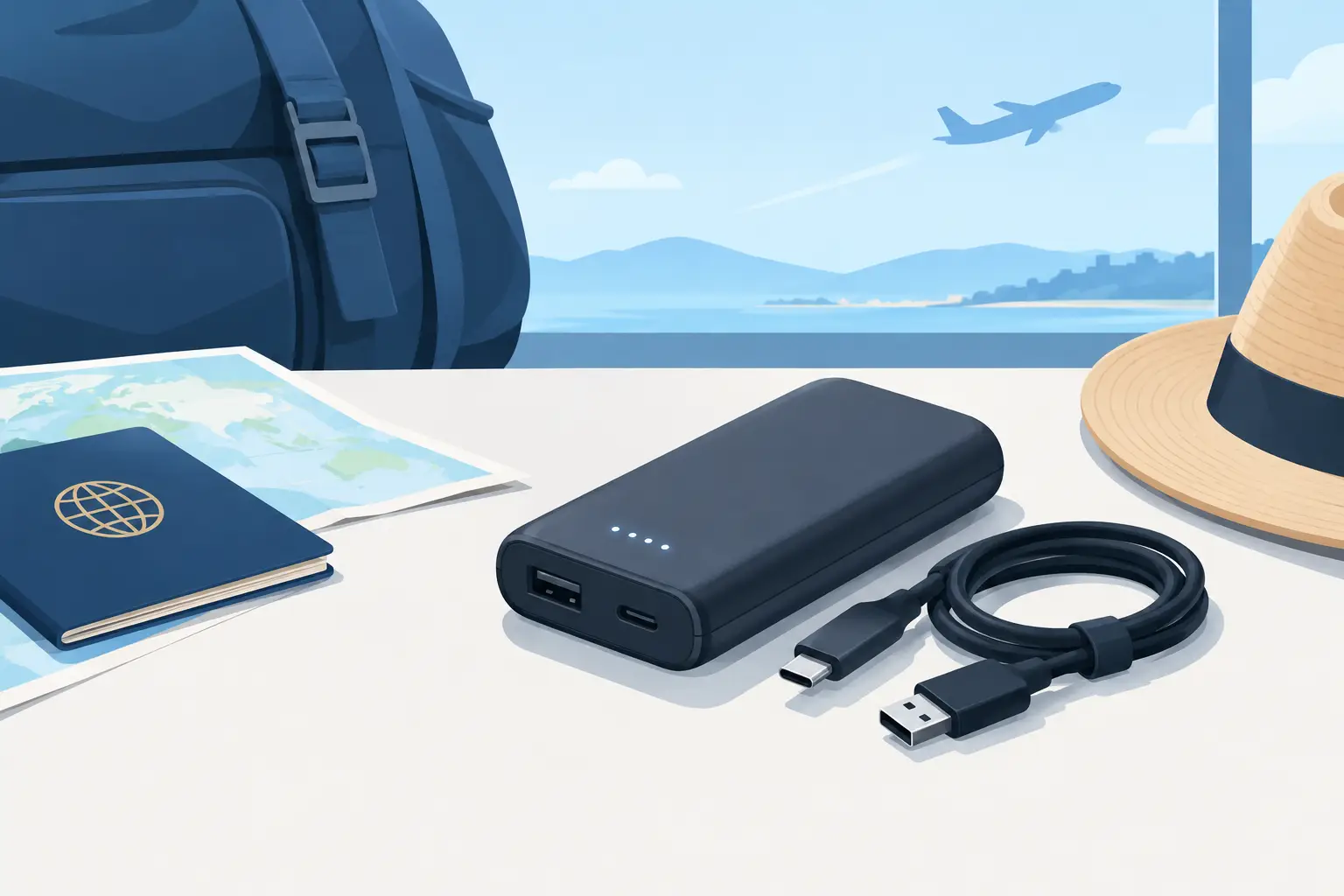
A dead phone at the airport is annoying. A dead phone when your boarding pass, hotel address, ride app, and work messages are all on it is a real problem. The right portable charger for travel keeps essential devices working without adding a brick-sized burden to your carry-on.
Buying one is not just about choosing the largest number on the package. Capacity matters, but so do charging speed, USB-C output, port selection, airline rules, and how much weight you are willing to carry every day. Here is how to choose practical backup power for the way you actually travel.
Start With the Devices You Need to Charge
A weekend road trip with one smartphone calls for a different power bank than a five-day work trip with a phone, tablet, earbuds, and laptop. Start by identifying what will need power away from an outlet and how often you expect to recharge it.
For most travelers, a 10,000mAh power bank is the useful middle ground. It is compact enough for a jacket pocket or personal bag and can typically recharge a modern phone around one to two times, depending on the phone model and charging losses. It is a solid choice for flights, day trips, conventions, and long drives.
Move up to 20,000mAh if you are traveling for several days, sharing power with another person, using a tablet, or spending long stretches away from wall outlets. The trade-off is clear: more capacity means more weight and a larger footprint. A 20,000mAh unit is usually better in a backpack, messenger bag, or carry-on than in a pocket.
Laptop users need to look beyond the mAh figure. A power bank must support USB-C Power Delivery at a high enough wattage for the computer. Many lightweight laptops can charge from 30W to 45W, while larger models may require 65W, 100W, or more. Check the charging requirement printed on your laptop's original adapter before you buy.
Capacity Is Useful, but Watt-Hours Matter for Flying
Airlines generally require lithium-ion power banks to travel in your carry-on bag, not checked luggage. The reason is simple: crew can respond to a battery issue in the cabin, but not easily in the cargo hold.
Most airlines allow power banks up to 100 watt-hours without special approval. Some may permit batteries from 100Wh to 160Wh with approval, but policies vary by airline and route. Check your carrier's current rules before packing, especially for international travel.
Watt-hours are what airlines use, while many product listings lead with milliamp-hours. You can estimate watt-hours with this formula:
mAh × battery voltage ÷ 1,000 = Wh
A typical 10,000mAh power bank is around 37Wh, and a typical 20,000mAh model is around 74Wh. Both are generally below the 100Wh limit. A 26,800mAh unit is often close to 99Wh, which is why that capacity is common among frequent flyers who want the most energy possible within standard carry-on rules.
Do not assume every large battery is airline-friendly. Look for the Wh rating printed clearly on the unit. That label can save time if airline staff need to verify it.
Choose a Portable Charger for Travel by Charging Speed
Capacity tells you how much energy a power bank stores. Output tells you how quickly it can deliver that energy. This is where a cheap backup battery can become frustrating, particularly when you have 20 minutes at a gate instead of two hours at a hotel.
For phones, USB-C Power Delivery with 20W output is a practical target. It supports fast charging on many newer phones and can add meaningful battery life during a short stop. If you use an Android phone that supports higher charging rates, a 30W or 45W charger may be worthwhile, but only if the power bank and cable support the appropriate standard.
For iPhone users, USB-C Power Delivery is the key feature to look for. For Android users, Power Delivery is widely useful, while some brands also benefit from specific fast-charging protocols. A charger can list a high maximum wattage but still charge your device slowly if their standards do not match. Check your device specifications when speed is a priority.
The cable matters just as much. A worn-out cable or an older low-power USB-A cable can limit charging speed. Pack a reliable USB-C to USB-C cable for newer phones, tablets, and laptops. If you carry older devices, add the cable they require rather than assuming one cable will cover everything.
Ports Should Match Your Real Setup
One USB-C port is enough for a solo traveler with one phone. Two or three ports make more sense if you carry several devices or travel with family. A power bank with USB-C input and output is especially practical because the same cable can often recharge the power bank and charge your phone.
Pay attention to shared output. A battery may advertise 65W total output, but that power can be divided when two devices are connected. For example, a laptop and phone may both charge, but the laptop could receive less power than it would from a single-port setup. That is not a defect. It is a normal limitation of how the charger distributes available wattage.
A built-in cable is convenient for quick trips because there is one less item to forget. It is less flexible if the cable gets damaged or does not match every device you own. Detachable cables remain the better option for travelers who use mixed gear or want an easier field replacement.
Size, Weight, and Durability Are Daily-Use Features
The best power bank is the one you will actually bring. A high-capacity model left in a hotel room is less useful than a smaller charger in your day bag.
For minimal packing, choose a slim 5,000mAh to 10,000mAh unit with USB-C fast charging. For heavy use, accept the extra weight of a 20,000mAh model and make room for it in your carry-on. If you are packing tools, cameras, or work equipment, consider a charger with a tougher housing and protected ports. Those details matter when gear is being moved from truck to airport to job site.
A clear battery-level display is also more useful than a single blinking light when you are planning a full day away from power. It lets you decide whether to recharge the bank before leaving your hotel instead of guessing.
Do Not Forget How You Will Recharge the Power Bank
A large battery that takes all night to refill can create its own travel problem. Check the input rating, not only the output rating. USB-C input at 18W or higher is a good baseline, while 30W or faster input is useful for larger 20,000mAh and laptop-capable models.
Your wall charger needs to support that input speed, too. If your power bank accepts 30W but you plug it into a 5W adapter, it will charge slowly. A compact USB-C wall charger with enough wattage for both your power bank and laptop can simplify your packing list.
For road travel, a USB-C car charger is a practical backup. It can top up the power bank while you drive, leaving your battery ready for a long day after you arrive.
What to Avoid When Buying a Travel Power Bank
Very low-priced chargers can be useful for light, occasional backup power, but be cautious with vague listings. If capacity, watt-hours, output wattage, and safety information are missing, you cannot confidently compare the product or bring it through airport screening.
Avoid buying capacity you do not need just because the number looks impressive. Bigger banks cost more, weigh more, and take longer to recharge. Also avoid relying on wireless charging alone for travel. It is convenient at a desk or on a nightstand, but wired USB-C charging is generally faster, more efficient, and more reliable when you need power quickly.
For a practical option, look for clearly labeled capacity, USB-C charging, the output you need, and a form factor that matches your bag. VOLTKITS makes it easier to compare useful tech accessories alongside the cables, car chargers, organizers, and everyday gear that make a trip run better.
Before your next departure, charge the power bank fully, put it in your carry-on, and pack the correct cable beside it. That small bit of preparation can keep a low battery from becoming the thing that slows down the whole trip.